Wedding Planning Guide
Planning a Jewish Wedding in Burbank
A Jewish wedding asks more of a venue than most celebrations: a beautiful place for the chuppah, separate rooms for the moments before the ceremony, a dance floor that can hold the hora, and a team that says "tell us how your family celebrates" instead of handing you a package. Here is how those pieces map onto the Hollywood Burbank Convention Center — with the published numbers for every space.
A place for the chuppah
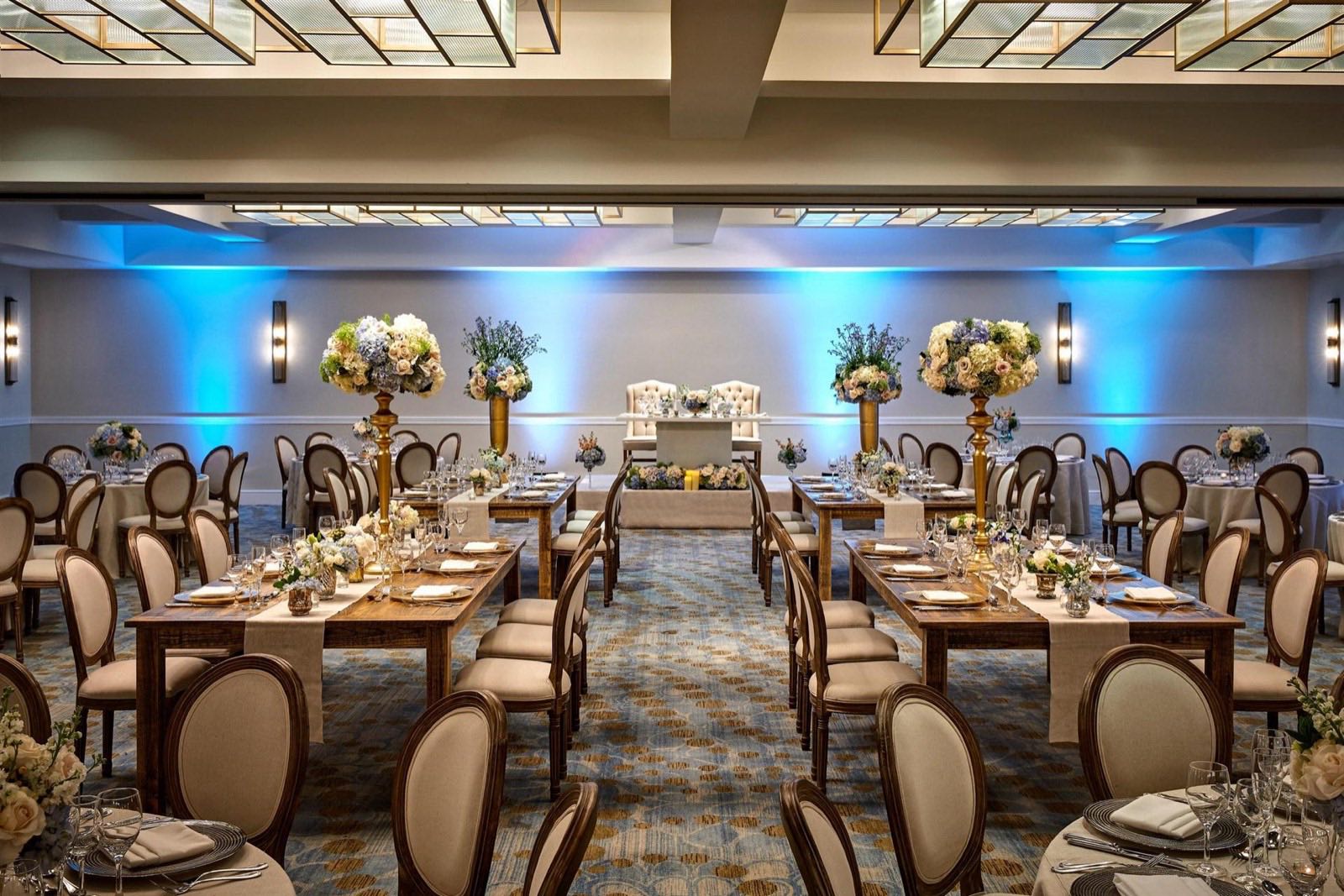
Many couples marry under the chuppah outdoors, under the open sky. The East Courtyard gives the ceremony 4,700 square feet of California outdoors, framed by palms, with seating for up to 150. For indoor ceremonies — or a larger guest list — the ballrooms carry the chuppah with room to spare: the City Ballroom at 4,704 square feet, or the Academy Ballroom at 15,015 square feet under 18-foot ceilings.
The rooms around the ceremony
The celebration often begins before the procession. In many communities the kabbalat panim reception, the tisch, and the bedeken each want their own space — close together, but distinct. Because the whole convention floor is a single level, that flow is a walk, not an elevator ride:
- Kabbalat panim and cocktail moments — the City Ballroom's private foyer (3,655 sq ft) or the glass-lined Academy Ballroom Foyer.
- The tisch — a boardroom or parlor with a real table: the Producer rooms or an East Parlor.
- Yichud — after the ceremony, the couple's first private moments need a quiet, dedicated room nearby; the parlors are made for exactly this.
Room for the hora
The hora needs what most venues can't give it: open floor. Chairs lifted, circles widening, the band going long. The Academy Ballroom seats 1,300 at banquet rounds and still holds a dance floor at its center — and if your guest list is closer to 400, the City Ballroom keeps the same energy in a room that feels full, warm, and yours.
Catering and kashrut: the questions to ask
Kosher requirements differ from community to community — supervision, sourcing, kitchen arrangements, and who certifies what are decisions that belong to you, your rabbi, and your supervising agency. Bring those requirements to the events team early: tell us what your celebration needs, and we will work through the arrangements together with your officiant and caterer. The right first questions for any venue conversation:
- What kitchen arrangements are possible for a supervised kosher caterer?
- How are meals for supervision staff and vendors handled?
- Can the timeline flex around candle-lighting and havdalah times for a Saturday-night celebration?
Choosing the date: how the calendar shapes the year
Jewish wedding dates follow the Hebrew calendar, and practices vary by community — your rabbi is the authority on what fits your family's observance. In broad strokes, couples planning around traditional practice usually consider:
- Shabbat — weddings are traditionally not held from Friday sundown through Saturday nightfall, which is why Saturday night and Sunday are the classic Jewish wedding slots.
- The Omer period — in the weeks between Passover and Shavuot (spring, typically April–June), many communities pause weddings, with celebrated exceptions such as Lag BaOmer. Customs differ widely here.
- The Three Weeks — from the 17th of Tammuz through Tisha B'Av (mid-summer, typically July–August), weddings are traditionally not scheduled.
- Favored windows — late spring after Shavuot, late summer after Tisha B'Av (Tu B'Av, the holiday of love, is a beloved date), and the long run from autumn after the High Holidays through early spring.
Because these dates shift on the civil calendar every year, confirm the exact windows for your year with your officiant before you fall in love with a Saturday night. Once you have the date, Burbank does the rest: the Los Angeles Marriott Burbank Airport has 488 guest rooms and suites for every branch of the family, sits directly across from Hollywood Burbank Airport for out-of-town guests, and puts Sunday-brunch space steps from the ballroom.
A weekend, not just a wedding
Jewish weddings are often weekend-long gatherings — a welcome dinner, the celebration itself, and a farewell brunch. The East Courtyard hosts the open-air moments, E.D.B. — the hotel's outdoor restaurant with fire-pit seating — takes the after-party, and room blocks keep everyone under one roof from Friday arrival to Sunday goodbye.